E. Vaughn McPartland
Smith College
Religion
2026
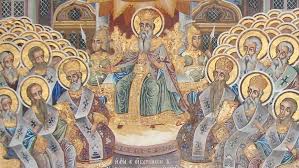
The Council of Chalcedon, the Fourth Ecumenical Council, commenced in 451 CE. Though not as well known as councils as the council of Nicaea (where the Nicene Creed originates from), it was important in establishing the church doctrine concerning the nature(s) of Christ, and it is still important to distinguishing Orthodox churches today. The non-Chalcedonian churches are the Malankara Orthodox Syrian Church, the Eritrean Orthodox Church, the Ethiopian Orthodox Tewahedo Church, the Syrian Orthodox Church, the Coptic Orthodox Church (in Egypt), and the Armenian Apostolic Church. These non-Chalcedonian churches are also known as “Oriental Orthodox,” a name that carries implicit assumptions about belonging.
The word Orient is used by the so-called Western World to describe the world that is outside, foreign, and (almost always) eastern. As scholar Edward Said writes in his seminal work Orientalism, “the Orient has helped to define Europe (or the West) as its contrasting image, idea, personality, experience.” In his writing, he also aims to describe the way the ideology of Orientalism, an ideology which seeks to identify and differentiate vastly different worlds, uses “institutions, vocabulary, scholarship, imagery, doctrines, even colonial bureaucracies and colonial styles”[1] to emphasize cultural difference and outsider-insider categories.
I want to focus on the Council of Chalcedon as a case study of Orientalism within the Orthodox world and how language is still affected by Orientalist categories of difference. I will refer to both the Chalcedonian and non-Chalcedonian churches as “Orthodox” (with a capital O), though the non-Chalcedonian churches are not universally accepted as “Orthodox.” I use “Orthodox” instead of “orthodox” to streamline writing and to use the language that the non-Chalcedonian churches who (with the exception of the Armenian Apostolic Church) use to describe themselves. I understand that the Chalcedonian and non-Chalcedonian churches are not in communion with each other, and that the non-Chalcedonian churches are independent (or autocephalous). If this use of language is at all ideologically charged, its ideological purpose is to expose and counter a linguistic Orientalism which naturalizes itself every time it is considered non-ideological. The erasure of the ideological mechanism of Orientalism is what allows it to consistently reproduce itself and assert itself as correct.
When we use the term ‘Oriental’, we assume a certain geographical position which it is Oriental in relation to. Whether or not the language’s purpose is negative, it functions to make a claim about which churches are deemed ideologically correct and which have a claim to the title of Orthodox. The centrality of the Byzantine Empire in the study and understanding of Orthodox history makes the ability to understand non-Byzantine Orthodox traditions a vitally important task. The Council of Chalcedon is a case study of the way the Orthodox churches have been severed, a kind of inter-Orthodox, smaller-scale schism. If non-Chalcedonian churches are also non-Byzantine churches, they are Orientalized by nature of being non-Byzantine. The countries of the former Byzantine Empire are “eastern” in relation to the countries we consider part of “the West,” and the Orthodox churches which reject the dogma of the Council of Chalcedon are eastern in relation to the churches of the former Byzantine Empire. As Naill Finneran writes in A Companion to Byzantium, “It is this relative state of theological, political, and geographical isolation of these communities, in a mainly ‘Byzantine – free zone’ that makes the study of their material culture so intriguing.”[2] Non-Byzantine Orthodoxy challenges the supremacy of the Byzantine Empire in the perception of Orthodoxy’s origin. If the Byzantine Empire, given its history as part of the Roman Empire, can be (at least partially) identified with a constructed shared western heritage (specifically in Europe), it can be understood in the minds of those who consider themselves heirs to this constructed shared heritage. Though the Byzantine Orthodox churches still maintain a level of outsider status when compared to the Protestant and Catholic churches (from a normative western perspective), the non-Byzantine Orthodox churches are doubly isolated from an imagined shared Christian heritage. This isolation is ingrained through differing ideological bases and geographical difference (this geographical difference is also established through Orientalism, since the Syrian and Armenian (Orthodox) churches are Oriental Orthodox churches and Jerusalem’s Orthodox church is not), though the fact of Jerusalem’s importance to all Abrahamic religions cannot be ignored here. The Council of Chalcedon can be viewed as the historical justification through which an Orientalist logic can be applied.
The Council of Chalcedon, as all the church councils did, intended to codify a specific, universally accepted church dogma, specifically an accepted dogma about Christ’s divinity and humanity, and how these natures interact with each other. One of its purposes was condemning Nestorianism, a conception of Jesus as having two distinct natures, and another purpose was condemning the idea that Jesus had only one nature (Monophysitism). It was named after the bishop Nestorius, though Nestorius himself was not necessarily a proponent of the ideology it describes. The ideology of Nestorianism could be seen as similar to Diaphysitism in certain ways, the ideology adopted by the Chalcedonian Orthodox churches which understands Christ as having two united and inseparable natures, but the ideologies and their bases are different. There were over 500 bishops present at the Council of Chalcedon, but the representatives of the non-Chalcedonian churches did not send bishops. They rejected the council, and as a result, they were no longer in communion with each other.
The churches that rejected the Council of Chalcedon’s decisions were ideologically Miaphyites, believing that Christ had one nature, simultaneously divine and human, rather than two natures, divine and human. When the term Monophysite is used (as is done in Liz James’ A Companion to Byzantium), the assumption is that these non-Chalcedonian churches only accepted one nature of Christ (namely the divine), but this does not properly explain their ideologies. The term Monophysite serves to further isolate the non-Chalcedonian churches from a generally accepted tenet of Christian belief, the belief in the simultaneous humanity and divinity of Jesus. If the non-Chalcedonian churches were truly Monophysites, they would not have accepted the Nicene Council, which decided that Jesus was God made incarnate through coming down to earth as a man. The Nicene Creed, which has been translated in multiple ways, says that God, “for us men, and for our salvation, having come down from heaven, became incarnate and was made man, and was perfectly born of the holy virgin Mary by the Holy Spirit.” and that “he took body, soul and mind and everything which is in man, truly and not by conjecture.”[3] Classifying non-Chalcedon churches as churches which do not accept the humanity of Jesus is probably a misclassification, and proliferation of this classification means that the non-Chalcedonian churches can be seen as not truly Christian; it understands the non-Chalcedonian churches only on Byzantine supremacist terms, only as churches whose otherness is emphasized. This framing, like the name Oriental Orthodox, is a use of vocabulary to complete an Orientalist task. As Said writes, “the Orient is an idea that has a history and a tradition of thought, imagery and vocabulary that have given it reality and presence in and for the West.”[4] By insisting, using the language of belief, that a bigger gap exists between the Chalcedonian and non-Chalcedonian churches than truly does, the Chalcedonian churches can assert the validity of their own Christianity.
The process of Orientalizing is incredibly useful for the Chalcedonian Orthodox churches because it essentially functions to minimize their “easternness.” Historical ties to Islam and the Ottoman Empire (in Orthodox countries like Greece), proximity to Asia (in Orthodox countries like Russia, which has also had a significant Muslim past), and differences in church practice might deem the Orthodox churches exotic wholesale, but the creation of the Oriental subject emphasizes relativity of difference. If we accept the Monophysite framing, we accept a process of exotification which deems the non-Chalcedonian churches’ Christianity as heretical, which is an ideological process, not a process of historical analysis. To accept these churches as Miaphysite is not only a rejection of Orientalist framing which serves to marginalize but also more accurate to their beliefs. The term Monophysite describes the churches’ belief that Christ has one nature but fails to explain the duality of this nature.
The Council of Chalcedon affected Orthodox churches by distinguishing Chalcedonian and non-Chalcedonian (Oriental) churches. The division brought about by the council is still around today, and the way language is used continues to reflect the way non-Chalcedonian churches are viewed by audiences, both Orthodox and non-Orthodox, especially those within “the West” in relation to the non-Chalcedonian churches. The use of language as an Orientalizing force may make the possibility of reunification for the churches even more difficult, since this language entrenches the outsider status of the non-Chalcedonian churches.
[1] Edward W. Said, Orientalism, United States: Random House, 1978, 2.
[2] Niall Finneran, “Beyond Byzantium: The Non-Chalcedonian Churches, Liz James, A Companion to Byzantium, Blackwell Publishing, 2010, 200.
[3] Armenian Apostolic Church of Sydney website
[4] Said, Orientalism, 5.